Steindesign
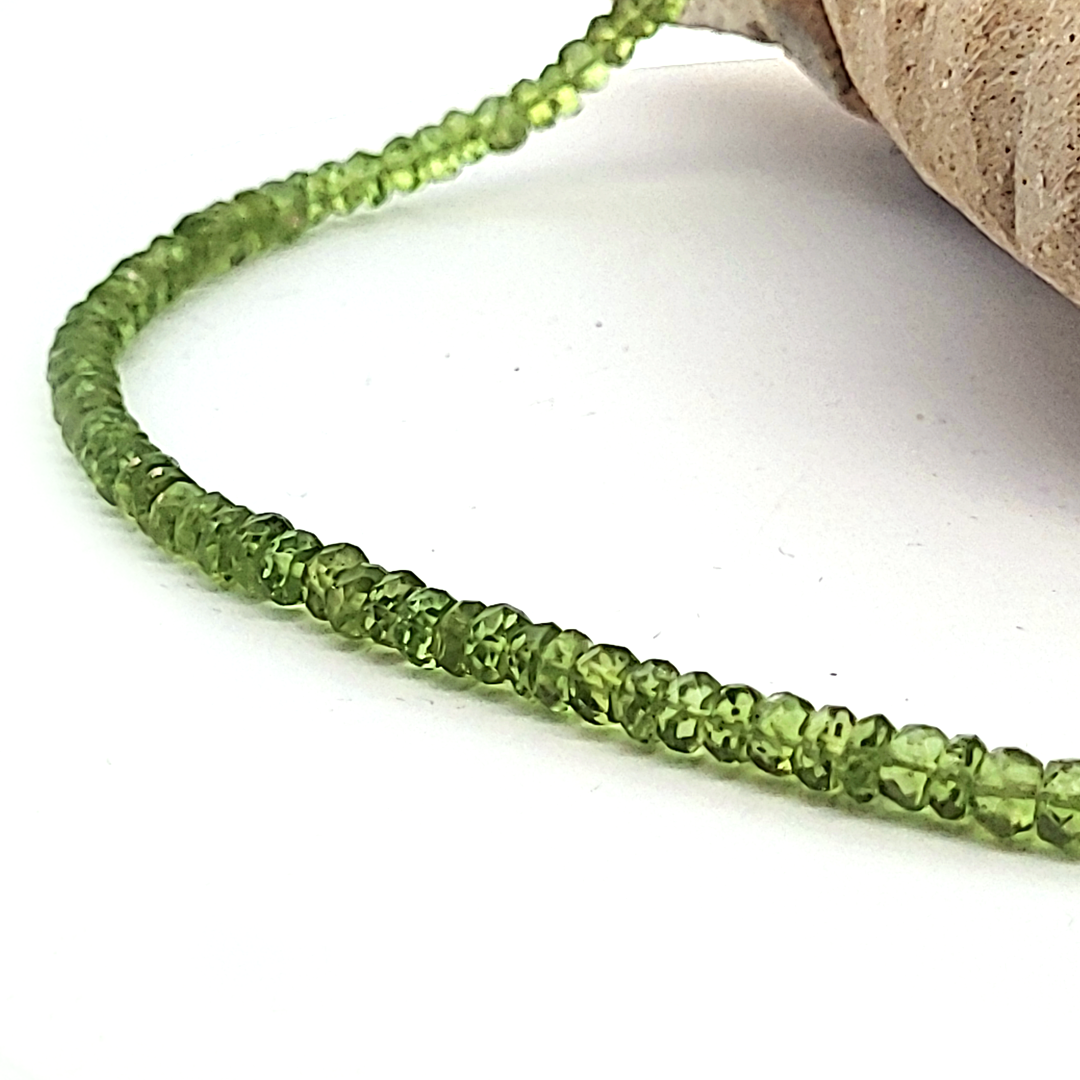
Peridot necklace, faceted button - 925 silver
Peridot necklace, faceted button - 925 silver
Delivery time: 2-3 working days (AT), 4-5 working days (DE)
Couldn't load pickup availability
Peridot is showcased in this gemstone necklace as button-shaped faceted beads in a vibrant olive green to yellow-green – a hue that no other gemstone quite achieves. The faceted buttons catch the light in delicate reflections, giving the necklace a fresh, lively radiance. Peridot is the gemstone variety of the mineral olivine ((Mg,Fe)₂SiO₄) from the nesosilicate group. Its green color is caused by iron, which is firmly incorporated into the crystal lattice – not as a trace element, but as an essential component of the mineral. Mohs hardness: 6.5–7. Peridot originates in the Earth's mantle and is brought to the surface by volcanic activity. Deposits: Egypt (Zabargad Island, mined for over 3,500 years), Pakistan, Myanmar, USA (Arizona). In ancient times, it was frequently confused with emerald – the Shrine of the Three Kings in Cologne Cathedral also contains peridots that were long thought to be emeralds. A special curiosity: peridot has also been detected in meteorites.
Significance in Crystal Healing
In crystal healing, peridot is considered a stone of renewal, warmth of heart, and inner cleansing. It is said to help release old wounds, promote compassion and gratitude, and provide support during phases of new beginnings. It is associated with the heart chakra. These attributions are based on tradition and are not scientifically proven. They do not replace medical treatment.
Product Details
Stone: Peridot (Olivine)
Mineralogy: Olivine, (Mg,Fe)₂SiO₄, nesosilicate, Mohs hardness 6.5–7, vitreous luster
Bead size: Button, faceted
Cut/Shape: Button, faceted
Necklace length: approx. 45–48 cm
Clasp: Lobster claw clasp, 925 sterling silver with extension chain
Color: Olive green to yellow-green (varies depending on iron content)
SKU: STKE0104
Natural product: Color intensity and inclusions vary per stone. Sensitive to acids and strong cleaning agents – please handle with care.
Teilen